Showing posts with label Midrash. Show all posts

Saturday, March 21, 2015

#7 On Adam's vs Satan's Fall (Midrash)

This is out of order from the original, as thematically it is tangential and confusing.  Reverend Law here is  responding to the Midrash, which most Christians are unfamiliar with,  except perhaps as hearsay or at best having read  John Milton's great poem, Paradise Lost,  also heavily based on it.

 The link for Paradise Lost takes you not to the poem but to the SparksNotes of it so you can read the highlights of it and see if you want to take up a full study of it. Like Dante's Inferno, it is a big poem and a real undertaking, but again, worth the time and effort.

Reverend Law uses Milton, at the time it was widely read or least popularly known, because his audience compromises not only of lapsed or even unknowing Christians (like academics), but also Jews  who neither  understand how Christian theology is indebted to the Old Testament as part of their Holy Bible nor realize the importance of the tie.


The Midrash is Jewish commentary on the 5 Books of Law (i.e. the first five books of the Old Testament commonly referred as the "Torah" or the "Law".  The Midrash  explains the logic and underpinnings to Jewish rabbinical students.  All religious Jewish males are required to be at some time in their life a rabbinical student, not only so that they all understand the Law but can also explain it to their families thoroughly or for that matter fill in if a rabbi (i.e. Jewish for teacher) is missing.  Jesus Christ, in the New Testament, makes the same requirement of his followers, except this time he included the word "all" including both male and females to be students of his Teachings.

---------------------------------------------------------------------------------------------------

Pryr-1.1-6] First, the Sin and Fall of Adam was that he had only committed a single Act of Disobedience, which was disobey the Command of God, not to lust after, nor eat of the forbidden Tree.


This was not an arbitrary Command of God, given at Pleasure, or as a mere Trial of Man's Obedience; but was a most kind and loving Information given by the God of Love to his new-born Offspring, concerning the State He was in, with Regard to the outward World. It was a Warning him to withdraw all Desire of entering into Sensibility of its Good and Evil; because such Sensibility could not be had, without his immediate dying to that Divine and heavenly Life which he then enjoyed.


"Eat not," says the God of Love, "of the Tree of Knowledge of Good and Evil, for in the Day thou eatest thereof you will surely die."

Of course he did not mean right then and there, either. He was talking that instead of living eternally, Adam would be living a "mortal" and shortened life.

But now the Angels, they were another thing.


While previous they were great and powerful Spirits, endowed with the Riches and Powers of their Creator and While they stood in Meekness and Resignation, under their Creator, nothing was impossible to them; there was no End of their glorious Powers throughout their whole Kingdom. There were Perpetual Scenes of Light, and Glory, and Beauty, rising and changing throughout all the Heights and Depths of this glassy Sea, merely at their Will and Pleasure.

But soon they began to admire and adore themselves, thinking  that there was some Infinity of Power hidden in they themselves,  that was being repressed and suppressed, by their Subjection to God. After mulling this over and over, they Fired themselves up, and grew intoxicated with this proud and haughty Imagination, and soon became resolved, to take their rightful Kingdom, with all its Glories, for themselves and oust God out.

No sooner did their Desires fly in this Direction of this Revolt but like a Swiftness of Thought, Heaven was lost to them.  It took no action, just their resolve and suddenly they found themselves as dark Spirits, stripped of all their Light and Glory and instead of Rising up and above God (as they had hoped) now no end of their eternal Sinking into new Depths of Slavery.


So like  a Wheel going down an endless  Mountain, these newly lost spirits, seemed to be in freefall and instead of reaching a bottom, they found that they must continually keep descending whirled down by the Impetuosity of their own wrong turned Will, and remaining in a continual Descent from the Fountain of all Glory, into the bottomless Depths of their own dark, fiery, working Powers.


There was no Hell, but what their own natural Strength had awakened; there were no Chains, just their own unbending, hardened Pride made by their renouncing their Subjection and loyalty to God.  Ignoring His will and feeling that their Will and Desire was enough.


And so too their glassy Sea, by the wrathful rebellious Workings of these apostate Spirits was broken all into Pieces, and now was a black Lake, a horrible Chaos of Fire and Wrath, Thickness and Darkness, a Height and Depth of the confused, divided, fighting Properties of Nature.


If this Revolt of Angels had not brought forth this disordered Chaos, no such Materiality as this outward World is made of had ever been known. Gross stones and compacted Earth, (mountains), wrathful Fire (volcanoes) here, dead Water (the Dead Sea and the Great Salt Sea) there, fighting (poisonous and deadly) Elements, with all their Vegetables and Animals, all Things that were never known in Eternity, but now were known and part of this mundane world..


Because it was the Spirit of Fire which had awakened by these rebel Creatures, so at last Fire, kindled by Word, thoroughly destroyed and purged the Floor of this Eden so that it was no more. And in those purifying Flames, the Sun, the Stars, the Air, the Earth and Water, parted from their Dross and instead of seeing a picture of what is, now they saw only illusions of transitory Things; like an Image in a Glass, that seems to have a Reality, but does not.


No longer will your life be such that Days and Years, like in Eternity have any Distinction from each other but Instead it will be a a life such as Animals and Insects, without a Divine Sense, Capacity, or Feeling. And so like theirs, your Nature will have nothing in them, but Chaos.


And so it was into this illusionary world that now Adam found himself, having to know for himself what was real and what was not and having without a guide, to have to learn through strife which was the right path to take.

Saturday, October 18, 2014

#3.6 The Kabbalah and Justice

Justice and the Kabbalah regarding the Spirit of Prayer

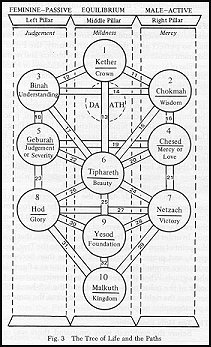
treeoflifebw
The Tree of Life, commonly called the Kabbalah, associates Mercy with Judgement, as  they are opposite each other : Mercy is the 4th sefirot and Geburah or Judgement is 5.  These are two of the divine attributes of Yahweh.

The Hebrew Alpha-bet reads right to left, and so does the tree.   The left side where  Judgement (Geburah) resides is Feminine, while the Right is Active and Masculine (Chesed #4).  This means that even numbers are active while uneven numbers are unstable and passive – like the atom they receive instructions.

Then there is the Middle Pillar or the spine of tree,.  If one reads up  Malkuth #10 to #1 Kether, as you ascend the tree,  you must be one of the Kingdom i.e. a believer.  Nothing happens without that first step towards God.  From there, you need solid foundation (yesod) in His teachings and ways. Tipareth the central sefirot, typically translated as Beauty, is not physical beauty, but a total equilibrium, absolute balance between the left and right arms of the Tree.

As we continue on with the Spirit of Prayer, keep in the mind the picture of the Tree and how Law describes the fall.  It is  an intertwining of God himself and his teaching, esoteric philosophy, Jewish mysticism and Christian religious reflecting on the Four divine attributes of Malkuth, Yesod, Tipareth and Kether that together help man balance himself between illusion and the real (mind).  They are the Golden Mean man should be striving towards in this life.
The word Justice, shows up on the tree typically as HOD or splendor.  It too is often misunderstood as the splendor of God’s bounty, but the noun splendor in English means “the exercise of authority in vindication of right by assigning  reward or punishment,”
It came from the Old  French ” justise” and probably was imported during the Norman conquest.  The Old Fr. word  itself is from the Latin . justitia “righteousness, equity,” and from the idea justus “upright, just” (see the word just (adj.)). The O. Fr. word had widespread senses, including”uprightness, equity, vindication of right, court of justice, judge.  How that relates to HOD or Splendour is very Talmudic:  the Glory of the Law of God or Natural Law. 
When Justice was first used  in English c.1200 it was just as a title for a judicial officer, or judicial administrator or as positive law and while that seems that there are no heavenly implications, one must remember the biblicial and esoteric statute "as above, so below" so that the positive law was supposed to reflect Natural Law and not be a perversion of it.
I created this image. The Kingdom of Mercia at...


Mercian was a language spoken in the Anglo-Saxon kingdom of Mercia (roughly the Midlands of England). Together with  Northumbrian, it was one of the two Anglian dialects of Britain before the Norman Conquest and the Kingdom of Mercia at its greatest extent (7th to 9th centuries) is shown in green, with the original core area (6th century) given a darker tint.

In the Mercian hymns by Geoffrey Hill,  the Latin word justitia is glossed into Old English  as   rehtwisnisse or right witness -- hence we "swear" with our right hand on the Bible that we are telling the truth or damning our immortal soul if we are lying.  Of course in polygot society that does have problems as Moslems are allowed to lie if it will further the cause of Islam.
Latin does not carry over per se, the Greek idea, that Justice is blind but adds a nuance that Justice is “weighty” referring back to the Egyptian idea of Ma’at’s weighing a man’s heart at death to see how far it had fallen from the original ideal.

English does do a lovely job of marrying the two ideas into a new whole.

Sunday, October 5, 2014

#1.0 Title Spirit of Prayer

The Spirit of Prayer

or

The Soul Rising out of the 

Vanity of Time

into the 

Riches of Eternity


In TWO PARTS

by William Law, M.A.

The Fourth Edition
Revised and Corrected by the Author 1758 


originally reformatted and annotated
January in the year of our of Lord, 2011


  Some Matters preparatory to the Spirit of Prayer by William Law.

The torments of the damned in hell - geograph....

The torments of the damned in hell (Photo credit: Wikipedia)
The original format is here on Christian Classics but it is of the 1749 version. Recently I got a hold of the revision by Reverend Law  in 1758.  That made me decide to update my adaptation of the book here on Blogspot,  where I  originally started my work, instead of continuing it on WordPress, where I moved the blog, in 2012.

Part of my reasoning for return, was  to the surprising lack of interest in the piece.  Over the two years that I have been WordPress I have noticed a distinct difference in the reading viewership of the two sites with Google being superior, at least for a religious audience.  Frankly, that surprised me.

On Scribd.com  that the whole pdf of the 1758 can be found ;  Christian Classics  has only the the first edition. I have noticed many differences and I do think that the '58 edition is the better one.  That means though, starting my work from scratch, but to be honest, my original work was a mix-up and hard to follow, but I doubt that was the reason for lack of viewership on WordPress.

What I have done is paraphrase,   Law's writings,  while still trying to keep the original capitalizations  as I think that they had some flavour to the piece,  but updating the spellings and grammar,  when they are so different from Modern English as to be either distracting or misleading.  When necessary I had added (in parentheses) meanings of archaic words.

In correcting, Rev. Law's grammar, that often entails, breaking up some of his very long Proustian passages as well explaining the  analogies, or modernizing them as the case may be so that they relevant.    Finally when Law refers to verses in the Bibles I have copied the whole verse into the text so that the reading is seamless,  and one does not have to check back and forth between the piece, and the Bible for references as modern audiences are not as conversant with the Bible as former ones were (remembering that reading implied a solid education).  This  latter update has been personally very helpful.  I have tried to use either the KJV or the ASV; sometimes I have used the modern NET Bible -- in all cases I have relied as far as possible on texts in the public domain.

When using the KJV because I know many find it difficult to read, I have put in the bridges that fill in the gaps look for this  [   ]  within the scripture here is an example.  As time and familiarity with KJV and other Bibles grow, you will find that the [] are like training wheels and no longer needed.

Nehemiah 13 King James Version (KJV)
13 On that day they read in the book of Moses [to] the audience of the people; and therein was found written, that the Ammonite and the Moabite should not come into the congregation of God ever; 2 Because they met not the children of Israel with bread and with water, but [instead] hired Balaam -- a pagan god -- against them, that he [our Lord] should curse [the Israelites] : [and so ]  our God turned the curse into a blessing.

Something about Law:


Samuel Johnson , the great British essayist, & John Wesley, the founder of Methodism, called William Law their spiritual father. He was a personal tutor, to Edward Gibbon, father of the great historian and writer of The History of the Decline and Fall of the Roman His influence of many English thinkers and religious thought is profound and unfortunately, forgotten.

Both Johnson & Wesley, felt that Law was as integral to Protestant thought as Martin Luther, primarily because he outlined the Christian ethical ideal for human life,  and how to achieve it -- exhorting his audience to be steadfast in discipline & constant inprivate prayer. Where Rev. Wesley disagreed with his spiritual mentor, and it quite was strongly,  was in Law's using the Midrash* & his emphasis on the mystical experience of "knowing God".

While this idea of Christian mysticism had long been a facet of Eastern Orthodox prayer, and in the Lives of the Roman Catholic  Saints (St Joan of Arc was burnt at the stake for her "hearing voices" from God on how to save France; St Bernadete was considered too stupid to have actually had a visitation, etc.),  it was a very alien idea to the Protestant "no frills" literal-text ethic.

Mysticism though has a strong universal attraction for man, and it can be found throughout the world in various apparitions like Chinese Taoism, Modern day Kabbalists, Buddhism and Muslim Sufism, but for Wesley the "literal reading" (no metaphor, similes or symbols)  of the Good Book, had no place in their mindset, and Wesley heavily objected to this whole idea of Christian mysticism & the creation of a Personal Jesus.

Law though,  insisted that there much Bible precedence for it, like 2 Peter 1 v21's explanation of the historical role of prophecy: "For the prophecy came not in old time by the will of man: but [by] holy men of God [who] spake as [though] they were moved by the Holy Ghost," [KJV] and thankfully  Rev. Jonathan Swift of Dublin and the poet, Alexander Pope, urged him in many meetings and much correspondence, on despite the Wesleyan outrage & thankfully Law listened to better heads and wrote on.
I hope you enjoy this adaptation, & that it  eases your questions, and comforts your worries, as we both grow stronger in Our Father.

============
The Midrash is commonly defined as the process of interpretation, where  the rabbis fill in "gaps" of understanding that are found in the Torah.   Today that is often done with the various "Commentaries" that are either separate or part of the Holy Bible itself.  In both cases, the Midrash and current commentary, they are a literature that seeks to ask the questions that if the  reader/listener could, ask the teacher (Rabbi/writer). 

#56 The final prayer